AI investment is soaring, as businesses across all industries seek to harness the technology’s power to transform their operations, products, services and user experiences. Many of those dollars are flowing to generative AI and agentic AI initiatives to grab business imagination and ingenuity. Yet businesses are making substantial investments in machine learning as well, because they view ML as the best technology for many critical use cases. Globally, the ML market is expected to hit $282 billion in 2030, up from nearly $56 billion in 2024, with an annual growth rate of 30.4% through the end of the decade. according to Grand View Research.
“Even though many of the techniques of the latest large language models capture the most attention, machine learning is still very relevant today as many business applications continue to happen with machine learning,” said Waldyn Martinez, associate professor of information systems and analytics at Miami University’s Farmer School of Business.
Benefits of machine learning
Machine learning features software systems capable of analyzing data and offering actionable insights based on that analysis. It continuously learns from that work to produce more refined and accurate insights over time. Many of the AI capabilities companies use are specifically associated with machine learning, from online product recommendations to customer service chatbots.
The benefits of machine learning can be grouped into the following four categories, said Vishal Gupta, partner at research firm Everest Group.
Efficiency. This advantage is achieved primarily through increased productivity or optimized processes.
Effectiveness. ML can improve the quality of work done.
Experience. Workers, customers and other stakeholders have a better overall interaction when using ML.
Business evolution. ML enables new products, services and market opportunities.
Machine learning in the era of generative and agentic AI
The business use cases ML enables will be powered by the technology for the foreseeable future, because It’s still the most efficient and cost-effective technology for those tasks, according to industry observers.
“Machine learning is the backbone of today’s business, turning data into insights and insights into action and predictability. That’s why machine learning is highly useful,” said Adnan Masood, chief AI architect at digital transformation services company UST. The business use cases powered by the technology are “where machine learning delivers value,” he said.
GenAI is the interface layer and agentic is the orchestration layer. … It’s not either-or, it’s a combination of these that gives the best results. Adnan MasoodChief AI architect at UST
GenAI and agentic AI are also key components of those same business use cases and have changed the mix. “Machine learning is still the engine for those things,” Masood said. “And now GenAI is the interface layer and agentic is the orchestration layer. … It’s not either-or, it’s a combination of these that gives the best results.”
A financial services firm, for example, would use ML to detect anomalies in a stock portfolio, Masood said. It would use GenAI to build the interface that alerts workers and lets them query systems about anomalies, and it would use agentic AI to trigger and execute workflows to address the anomalies.
Common ML use cases
Although there are many use cases for machine learning, experts highlighted the following 12 top applications for business today.
1. AI assistants
The majority of people have had direct interactions with ML at work in the form of AI assistants and their more basic cousin, chatbots. Many AI assistants use LLMs for their conversational components and interface, said JJ Lopez Murphy, head of data science and AI at consultancy Globant.
Aptly named, these software programs use ML and natural language processing (NLP) to mimic human conversation. They work from preprogrammed scripts to engage individuals and respond to their questions by accessing company databases to provide answers. Many AI assistants use LLMs for their conversational components and interface, Lopez Murphy noted.
Early generations of chatbots followed scripted rules that told the bots what actions to take based on keywords. ML enables chatbots to be more interactive and productive. It lets them be more responsive to a user’s needs, more accurate with responses and ultimately more humanlike in its conversation. Digital assistants such as Apple’s Siri and Amazon’s Alexa are everyday examples of chatbots, as are the chatbots that provide the first point of contact for most customer call centers.
2. Recommendation engines
ML also powers recommendation engines, which are most commonly used in online retail and streaming services. Algorithms process data, such as a customer’s past purchases along with data about a company’s current inventory and other customers’ buying history, to determine what products or services to recommend to that particular customer.
Recommendation engines let companies personalize a customer’s experience, which helps with customer retention. They also increase sales by offering products and services that more closely match what customers like and want.
As with digital assistants, businesses are incorporating GenAI into their recommendation engines, Lopez Murphy said, adding that “machine learning is still at the heart” of this capability.
3. Dynamic pricing
ML lets companies adjust their product and service prices in near real time in response to changing market conditions, a practice known as dynamic pricing.
ML systems use numerous data sets, such as macroeconomic and social media data, to set and reset prices, typically for airline tickets, hotel room rates and ride-sharing fares. Uber’s surge pricing, where prices increase when demand goes up, is an example of how companies use ML algorithms to adjust prices as circumstances change.
Sales and marketing teams are the most prolific ML users because the technology supports much of their everyday activities.
Businesses are also adding GenAI to their dynamic pricing capabilities, Lopez Murphy said. GenAI lets them use more data and more accurate data, which in turn enables better results from ML engines.
4. Targeted marketing and sales forecasting
In many businesses, sales and marketing teams are the most prolific ML users because the technology supports many of their everyday activities. ML capabilities are typically built into the enterprise software that supports those departments, such as CRM systems. The following marketing activities are supported by ML:
Customer churn modeling. Marketers use ML and customer churn modeling to identify which customers might be souring on their company, when that might happen and how that situation could be resolved. Algorithms pinpoint patterns in huge volumes of historical, demographic and sales data to identify and understand why a company loses customers. The company can then use ML capabilities to analyze the behaviors of existing customers and identify which are at risk of taking their business elsewhere, why they’re leaving and what steps could be taken to retain them. “Think of it as a recommendation engine built for retail,” Masood said.
Customer segmentation.Customer segmentation is a business practice in which companies categorize customers into specific segments based on common characteristics such as age, income or education level, so marketing and sales can tailor their products, services, advertisements and messaging to each segment.
Sales forecasting. ML is used to set the optimal prices for products and ensures the organization delivers the right products and services to the right areas at the right time through predictive inventory planning and customer segmentation. For example, large retailers use it to predict which inventory will sell best in specific stores based on seasonal factors affecting a particular store, the demographics of that region, what’s trending on social media and other data points, Masood said.
GenAI and agentic AI are also making appearances in this space, working in conjunction with ML capabilities. Businesses are using GenAI to provide more accurate data to the ML algorithms. GenAI is also being used to capture data from social media posts, online images and customer feedback channels, Lopez Murphy said. Meanwhile, businesses are automating pieces of the workflow with agents to speed responses and support real-time tailored support.
5. Fraud detection
ML is used for fraud detection, particularly in banking and financial services, to alert customers of potential misuse of their credit and debit cards. It understands patterns and can instantly see anomalies that fall outside those patterns.
Financial, travel, gaming and retail businesses use ML to understand a customer’s typical behavior, such as when and where they use a credit card. Machine learning takes that information along with other data to determine in milliseconds which transactions are within the normal range and legitimate versus which are outside expected norms and likely fraudulent.
Businesses are layering in other AI capabilities, Martinez said. GenAI can provide context, using text and images to give a more complete picture of what’s happening. For example, GenAI can determine that a credit card holder is traveling internationally, adding context to transactions that might otherwise seem suspicious. The added context lets ML algorithms more accurately detect subtle anomalies while also reducing false positives, Martinez said.
6. Cyberthreat detection
ML’s capacity to analyze complex patterns and identify anomalies in high activity volumes makes it a powerful tool for detecting cyberthreats. Its ability to learn lets it continually refine its understanding of a business’s IT environment, network traffic and use patterns. Even as the IT environment expands and cyberattacks grow in number and complexity, ML algorithms continually improve their ability to detect unusual activity that could indicate an intrusion or threat.
Companies are also using GenAI to provide context to more advanced ML algorithms, Martinez said, enabling more accurate detection of subtle anomalies and reducing false positives much like GenAI and ML together enhance fraud detection.
7. Optimization
ML for process optimization is used across enterprise operations, from finance to software development, to speed up work and reduce human error. It’s particularly useful in logistics, manufacturing and the supply chain. Algorithms can analyze data and run simulations to determine optimal or near-optimal approaches that lead to the best results.
8. Decision support
Businesses have long used ML to help them make better decisions. Using a decision support system (DSS) to make better decisions cuts costs and enhances performance.
To support decision-making, ML algorithms are trained on historical and other relevant data sets, letting them analyze new information and run multiple scenarios at a scale and speed that humans can’t match. The algorithms can then offer recommendations on the best course of action.
In the healthcare sector, DSSes are used to help interpret medical imaging results, diagnose patients and develop treatment options. In agriculture, ML-enabled decision support tools incorporate data on climate, energy, water and other resources to guide farmers in their crop management decisions. In business operations, DSSes help management teams recognize trends, identify problems and speed decisions.
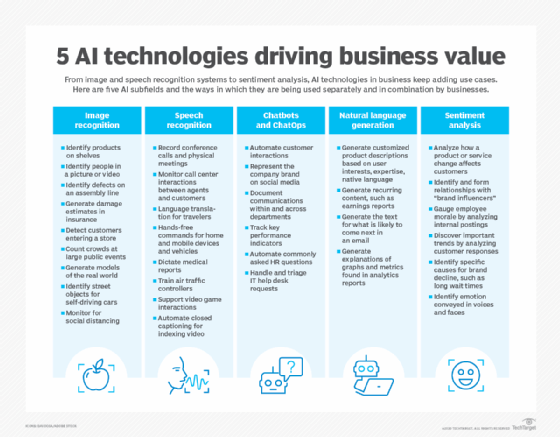
How five machine learning technologies are being applied in business.
9. Predictive maintenance
Predictive maintenance differs from preventive maintenance in that it can identify what maintenance should be done, not just that it needs to be done. ML uses historical operational data, performance data from IoT devices, supply chain and market prediction data, worker availability and other information to predict the optimal time to perform equipment maintenance. This approach minimizes the equipment downtime and maximizes equipment investments by avoiding unnecessary maintenance.
Farmers, mining and transportation companies are among the many types of businesses that use ML for predictive maintenance. Meanwhile, some companies use it to create new offerings, such as predictive maintenance scheduling services for equipment or vehicle customers.
10. Monitoring and QA
ML’s capacity to understand and distinguish patterns in data at a scale, speed and level unmatched by humans makes it useful for monitoring and quality assurance. For example, machine learning is commonly used to monitor supply chain operations, continually analyzing patterns to identify abnormal conditions that need attention.
ML technologies, such as deep learning, neural networks and computer vision, are also used to monitor production lines and other workplace outputs to ensure products meet established quality standards.
11. Sentiment analysis
Companies often use sentiment analysis tools to analyze customer reviews and other interactions to evaluate customer emotions. ML models can scan and analyze human language to determine whether the emotional tone exhibited is positive, negative or neutral. They can also be programmed to rate sentiment.
Sentiment analysis lets companies react more appropriately to customers’ needs. In a call center, for example, it can identify a customer’s tone and share that analysis with a chatbot or human agent to help adjust responses or recommended scripts based on those emotions.
12. Information extraction and knowledge management
Information retrieval and information extraction systems often use ML technologies, such as NLP, optical character recognition and intelligent character recognition, to automatically identify key pieces of structured data from documents, even if the information is held in unstructured or semistructured formats. Document processing efficiency and accuracy improve, and workers are relieved of mundane and repetitive tasks.
Businesses are also using machine learning and retrieval-augmented generation to extract relevant content from enterprise policy and procedure documentation. LLMs let people query in natural language. This combination of AI technologies helps businesses surface needed information fast, Masood said, speeding up decision-making and service in the process.
Mary K. Pratt is an award-winning freelance journalist with a focus on covering enterprise IT, cybersecurity management and strategy.